
Why Pigeons and Seagulls Fear Harris Hawks for Bird Control
Discover why Harris Hawks are the ultimate natural deterrent for nuisance pigeons and seagulls in urban and coastal environments. Learn how falconry offers humane bird control.
On this page
The Instinctive Fear of Harris Hawks in Bird Control
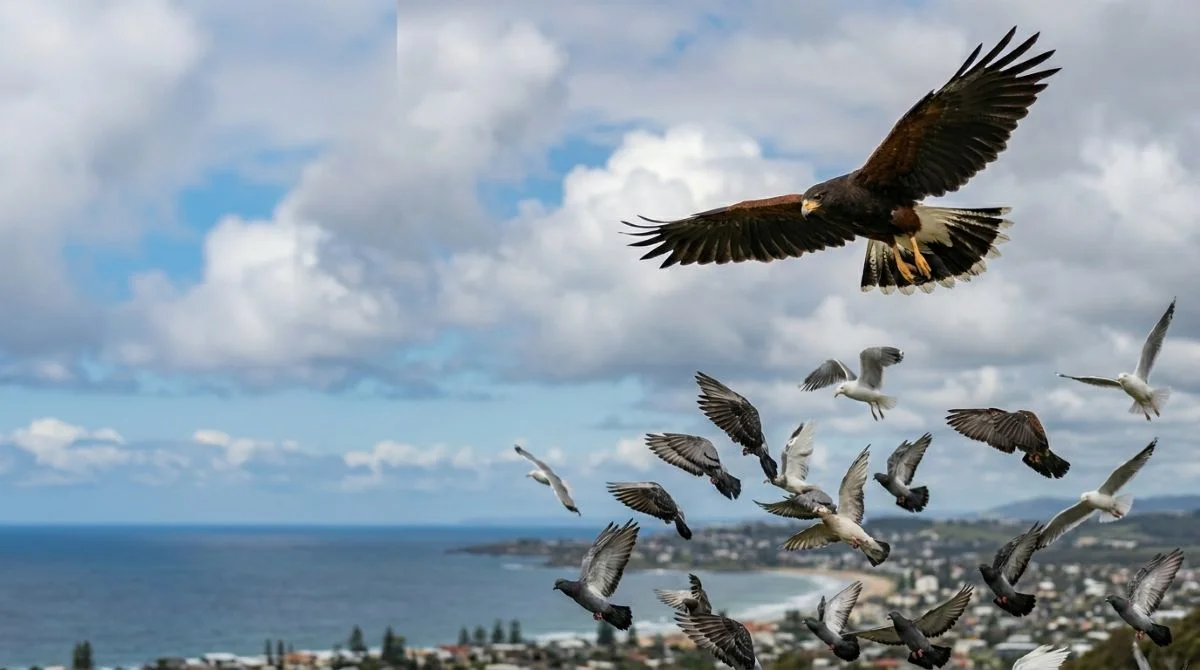
Pigeons (Columba livia) and gulls (including the common herring gull, Larus argentatus, and lesser black-backed gull, Larus fuscus) exhibit a profound, instinctive fear of natural predators, and this primal response is precisely why Harris Hawks (Parabuteo unicinctus) are incredibly effective in humane bird control programmes. Unlike many static deterrents such as netting or spikes, which address the symptom of bird presence, active falconry with a trained Harris Hawk addresses the root cause: the birds’ desire to inhabit a particular area. When a predatory bird like a Harris Hawk is introduced into an environment, nuisance birds perceive an immediate and credible threat to their safety, prompting them to relocate from the area.
At Hawking Pest Control by Enviroteck, we leverage these deeply ingrained instincts to provide an integrated, ethical, and highly successful bird management solution across Leinster, including high-pressure environments like Dublin City. Our licensed falconers, holding NPWS Section 22 licences and Lantra falconry training, expertly deploy captive-bred Harris Hawks. These magnificent birds create an environment of active deterrence that encourages pest bird populations to seek safer habitats elsewhere, establishing long-term behavioural changes rather than temporary fixes.
Understanding the Predator-Prey Dynamic
The success of hawking bird control lies in the hardwired predator-prey relationship that has evolved over millennia. Nuisance birds, whether feral pigeons roosting on commercial rooftops in County Dublin or gulls nesting on coastal industrial sites, are constantly assessing their surroundings for threats. The sight, and more importantly, the presence and flight patterns of a genuine raptor signals immediate danger. This isn’t merely a visual scare; it’s an overwhelming sensory experience that communicates a real, present threat to their lives and breeding success.
Harris Hawks are particularly suited for this role due to their social hunting behaviour in the wild, which makes them highly trainable and adaptable to various environments. Their distinctive flight profile, powerful wingspan, and predatory focus are immediately recognised by pest birds. Unlike a kite or a recording, a live Harris Hawk exhibits unpredictable movements and genuine hunting behaviours, reinforcing the perception of a persistent threat. This sustained pressure is crucial for long-term bird dispersal, as birds quickly habituate to static or passive deterrents.
The Role of Harris Hawks in Active Deterrence
Our hawking programmes are carefully designed to establish a "no-go" zone for pest birds. This is achieved through frequent, unpredictable appearances of our Harris Hawks over a period sufficient to convince the target bird population that the area is no longer safe for roosting, nesting, or foraging. For gulls, which often cause significant issues around coastal properties and landfill sites, especially species like the herring gull, Larus argentatus, and lesser black-backed gull, Larus fuscus, the presence of a raptor is a particularly potent deterrent. While Harris Hawks excel in many urban and industrial settings, for specialist gull dispersal on expansive coastal sites, we also employ peregrine and lanner falcons, species renowned for their speed and ability to operate in open areas.
The key here is active deterrence as opposed to passive proofing. While physical proofing methods such as netting and spiking are invaluable and form a critical part of an integrated bird-control programme for preventing access to specific spots, hawking works by altering the birds’ overall behaviour patterns. It convinces them to leave an entire area, reducing the overall population pressure and preventing new birds from moving in. This is especially effective for large, open spaces like industrial parks, sports stadiums, major commercial complexes, and public spaces where netting might be impractical or aesthetically undesirable.
Long-Term Changes in Bird Behaviour
The objective of using Harris Hawks and other raptors is not to harm the pest birds, but to change their behaviour permanently. Our licensed falconers manage the hawks to patrol specific areas, making the environment inhospitable for nuisance species. Over consistent sessions, the target birds learn that the site is dangerous, and this learned avoidance becomes ingrained. This makes falconry one of the most proactive and ethically sound methods available for bird control today, aligning with the humane principles outlined by organisations like the BPCA (British Pest Control Association) for effective pest management.
Consider the common starling (Sturnus vulgaris) or rook (Corvus frugilegus) creating noise and mess in an urban park or around a historic building. The sustained, unpredictable presence of a Harris Hawk during their roosting periods disrupts their patterns and forces them to find alternative, safer locations. This is a far more nuanced approach than merely blocking access; it shifts their perception of the territory.
Our 5-step bird-control process includes a thorough site assessment to determine the most effective strategy, which often involves a combination of active deterrence and physical exclusion. For instance, in an area with high feral pigeon activity, hawking might be used to drastically reduce the flock size and pressure, followed by targeted netting or spiking to prevent residual birds from re-establishing a foothold in critical roosting spots.
Legal and Ethical Considerations for Falconry in Ireland
All bird control operations in Ireland must adhere strictly to the Wildlife Act and relevant NPWS (National Parks and Wildlife Service) guidelines. As licensed falconers, we operate under Section 22 licences, ensuring that our use of Harris Hawks and other raptors is fully compliant, humane, and environmentally responsible. The birds we use are captive-bred, ensuring no impact on wild populations, and are meticulously cared for by our dedicated team, as detailed on our About Our Licensed Falconry Team page.
Our commitment to humane practices means our hawks are flown in a controlled manner, specifically to deter without causing injury. The mere presence of the raptor is typically enough to elicit the desired avoidance behaviour. This ethical foundation is paramount to our operations and underlies every hawking bird control programme we undertake.
For businesses and organisations in areas such as Tallaght, Dublin, suffering from persistent bird issues, understanding the nuanced application of falconry is key. It provides a powerful natural solution that is often preferable to visual or auditory deterrents that birds quickly ignore, or aggressive methods that can pose risks to non-target species.
Hawking Pest Control by Enviroteck is proud to offer Ireland's specialist humane bird control services using integrated falconry programmes across Leinster. For a tailored solution to your bird problem, whether it's pigeons, gulls, or other nuisance species, we invite you to book a free site assessment with one of our licensed falconers via our contact page.
This article is for informational purposes only. For a binding programme and quote, book a free on-site assessment with one of our licensed falconers.
Bird issue on your site?
A licensed falconer will survey the location, identify nesting zones, and outline a humane plan.
Book a free site assessmentFrequently asked questions
How do Harris Hawks deter pest birds without harming them?
Is falconry bird control humane and legal in Ireland?
What types of birds can be controlled using Harris Hawks?
How long does a hawking bird control programme take to be effective?
Can an integrated bird control programme combine falconry with other methods?
Reviewed & authored by
Terence Francis — Licensed Falconer
30+ years in Irish pest control. Licensed falconer flying Harris Hawks across Leinster — fully insured, NPWS-aligned.
Ready to clear the birds, humanely?
Licensed falconer, fully insured, Leinster-wide. Free site assessment with no obligation.